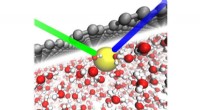
* Increased distance: The atoms in a liquid are close together and move around each other freely. In a gas, the atoms are much farther apart and move around randomly with much higher speeds.
* Increased kinetic energy: The atoms in a gas have significantly more kinetic energy (energy of motion) than those in a liquid. This is because they're moving faster and have overcome the attractive forces holding them together in the liquid state.
* Weakened intermolecular forces: The intermolecular forces (attractions between molecules) that hold the liquid together are much weaker in a gas. This allows the atoms to move freely and independently.
Think of it this way:
Imagine a crowded room full of people (like a liquid). They're close together and bumping into each other. Then, everyone suddenly spreads out and starts running around the room (like a gas). The people are still the same, but they have more space and are moving faster.
Here are some important points to remember:
* The atoms themselves don't change: The atoms in a liquid and a gas are the same type of atoms. Only their arrangement and energy levels change.
* Energy is required: To change from a liquid to a gas, energy must be added to the substance to overcome the intermolecular forces and increase the kinetic energy of the atoms.
* The opposite process is condensation: When a gas changes back into a liquid, the atoms lose energy, slow down, and come closer together.
Let me know if you'd like to delve into any of these points in more detail!