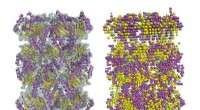
* Ice: In ice, water molecules are arranged in a highly ordered, crystalline structure. Each molecule forms four hydrogen bonds with its neighbors, creating a spacious, open lattice. This lattice structure is what makes ice less dense than liquid water.
* Liquid Water: When ice melts, the hydrogen bonds start to break, allowing the molecules to move closer together and become less ordered. The molecules can now move around freely and occupy a smaller volume, leading to an increase in density.
Here's a simplified analogy:
Think of ice as a bunch of people standing in a very organized line, holding hands (hydrogen bonds) and leaving a lot of space between them. When the ice melts, people start letting go of hands and moving around more freely, allowing them to pack closer together.
Key Points:
* Density: Liquid water is denser than ice, which is why ice floats.
* Hydrogen Bonds: The breaking and reforming of hydrogen bonds are crucial for the transition between ice and liquid water.
* Order: Liquid water has a less ordered structure than ice.
Let me know if you'd like more details about any of these points!