* Dissolution: The salt crystals dissolve into their individual ions: sodium ions (Na+) and chloride ions (Cl-). This happens because water molecules are polar, meaning they have a slightly positive end and a slightly negative end. These polar molecules attract the charged ions of the salt, pulling them apart and surrounding them.
* Formation of a solution: The dissolved ions are now dispersed evenly throughout the water, creating a homogeneous mixture called a solution.
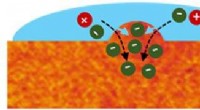
* Increase in conductivity: The presence of the ions in the solution allows it to conduct electricity. Pure water is a poor conductor, but adding salt makes it a much better conductor.
* Lowering of freezing point: Adding salt to water lowers the temperature at which it freezes. This is why salt is used on roads and sidewalks to melt ice.
* Raising of boiling point: The boiling point of water is also raised when salt is added. This is why salt is used in cooking to increase the temperature of boiling water.
* Changes in osmotic pressure: The presence of dissolved ions alters the osmotic pressure of the solution, which can be important in biological systems.
Overall, when salt is evenly mixed with water, it dissolves and creates a salty solution with different physical and chemical properties than pure water.