Here's a breakdown:
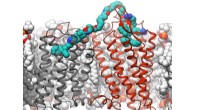
* Photosystem II is a protein complex embedded in the thylakoid membrane of chloroplasts.
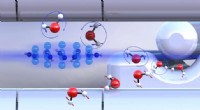
* Photolysis is the splitting of water molecules using light energy.
* Light energy excites electrons in chlorophyll molecules within photosystem II.
* Excited electrons are passed along an electron transport chain.
* Water molecules are split, releasing:
* Hydrogen ions (H+) which accumulate in the thylakoid lumen.
* Electrons (e-) which replace the lost electrons in chlorophyll.
* Oxygen (O2) which is released as a byproduct.
This process is crucial for photosynthesis as:
* Hydrogen ions contribute to the proton gradient across the thylakoid membrane, driving ATP synthesis.
* Electrons are used to generate NADPH, a reducing agent needed in the Calvin cycle.
* Oxygen is released as a waste product, but also essential for aerobic respiration in other organisms.