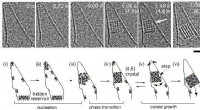
* Atoms are incredibly small: They are much too tiny to be observed with conventional microscopes. Even the most powerful electron microscopes only allow us to see very large molecules, not individual atoms.
* Phases describe the arrangement of atoms: The phases of matter (solid, liquid, gas, plasma) describe how atoms are arranged and move relative to each other. These arrangements are not directly "visible" in the sense of seeing a physical change.
* We observe the effects of phases: We infer the phases of matter by observing their macroscopic properties like density, compressibility, and how they respond to heat.
Instead of seeing the phases directly, we use various indirect methods:
* Spectroscopy: This involves studying the light emitted or absorbed by atoms. Different phases of matter emit different wavelengths of light, allowing us to infer their phase.
* X-ray diffraction: X-rays can be used to determine the arrangement of atoms in a solid, revealing its crystal structure.
* Computer simulations: Scientists can use computer models to simulate the behavior of atoms at different temperatures and pressures, allowing them to visualize the changes in phase.
In short, while we can't see the phases of atoms directly, we have powerful tools that help us understand their behavior and infer their phases.