The Reaction:
Copper (Cu) reacts with nitric acid (HNO₃) to produce copper(II) nitrate (Cu(NO₃)₂), nitrogen dioxide gas (NO₂), and water (H₂O).
The balanced chemical equation is:
Cu + 4HNO₃ → Cu(NO₃)₂ + 2NO₂ + 2H₂O
Explanation:
* Nitric Acid as an Oxidizer: Nitric acid acts as a strong oxidizing agent. This means it readily accepts electrons from other substances, causing them to be oxidized.
* Copper Oxidation: Copper is oxidized from its elemental state (Cu⁰) to copper(II) ions (Cu²⁺).
* Nitrogen Reduction: The nitrogen in nitric acid is reduced from +5 oxidation state in HNO₃ to +4 oxidation state in NO₂.
* Formation of Copper Nitrate: The copper(II) ions combine with nitrate ions (NO₃⁻) to form copper(II) nitrate, a soluble compound.
* Evolution of Nitrogen Dioxide: The reduced nitrogen atoms from nitric acid form nitrogen dioxide gas, which is a reddish-brown, toxic gas.
Observations:
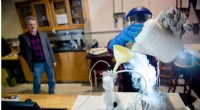
* Brown Gas: The reaction produces a brown gas, which is nitrogen dioxide (NO₂).
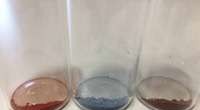
* Blue Solution: As the reaction progresses, the solution turns blue due to the formation of copper(II) nitrate.
* Heat Production: The reaction is exothermic, meaning it releases heat.
Why not a simple displacement reaction?
You might think that copper would displace hydrogen from nitric acid like it does with some other acids. However, nitric acid is a strong oxidizing agent, so it prefers to oxidize copper instead of being reduced by it.
Additional Notes:
* The concentration of the nitric acid influences the reaction. Concentrated nitric acid will produce more nitrogen dioxide gas. Dilute nitric acid will produce nitric oxide gas (NO) instead.
* The reaction is quite vigorous, and the fumes produced should be handled with care.
Let me know if you'd like more information on any of these aspects!