1. Conductivity Measurement
* Principle: Ionic compounds dissociate into ions when dissolved in water, creating a solution capable of conducting electricity. Molecular compounds, however, generally do not dissociate and their solutions have low conductivity.
* Procedure:
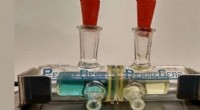
* Prepare a solution of the substance in water.
* Use a conductivity meter to measure the electrical conductivity of the solution.
* Interpretation:
* High Conductivity: Suggests the presence of ions, indicating an ionic compound.
* Low Conductivity: Suggests the absence of significant ions, indicating a molecular compound.
2. Colligative Property Measurements
* Principle: Colligative properties (like freezing point depression, boiling point elevation, and osmotic pressure) depend on the number of solute particles in a solution. Ionic compounds dissociate into multiple ions, increasing the number of particles and causing larger changes in colligative properties compared to molecular compounds.
* Procedure:
* Measure the freezing point, boiling point, or osmotic pressure of the solution.
* Interpretation:
* Large Changes: Suggest the presence of multiple ions (ionic compound).
* Small Changes: Suggest a smaller number of particles (molecular compound).
3. Chemical Reactions
* Principle: Ionic compounds often react differently than molecular compounds. For example, ionic compounds may form precipitates with certain reagents, while molecular compounds may not.
* Procedure:
* Perform specific chemical reactions known to differentiate between ionic and molecular compounds (e.g., adding silver nitrate to test for halide ions, adding a strong acid to test for carbonates).
* Interpretation:
* Characteristic Reactions: Indicate the presence of ions, suggesting an ionic compound.
* Lack of Reactions: May indicate a molecular compound.
4. Spectroscopic Techniques
* Principle: Spectroscopic techniques like infrared (IR) and nuclear magnetic resonance (NMR) spectroscopy can provide information about the structure of molecules.
* Procedure:
* Obtain IR or NMR spectra of the substance in solution.
* Interpretation:
* Ionic Bonds: Typically show characteristic peaks in IR spectra related to vibrational modes associated with ionic bonds.
* Molecular Compounds: Show characteristic peaks in IR and NMR spectra that indicate the presence of covalent bonds and specific functional groups.
Important Notes:
* Solubility: The solubility of the substance in water can provide a clue. Ionic compounds are generally more soluble in water than molecular compounds.
* Limitations:
* Conductivity measurements can be affected by impurities.
* Colligative property measurements may be less reliable for very dilute solutions.
* Spectroscopic techniques may require specialized equipment and knowledge.
Conclusion:
By combining multiple experimental techniques, you can obtain a more comprehensive understanding of whether a substance is present in ionic or molecular form when dissolved in water.