Here's a breakdown:
1. Strong Nuclear Force:
* This force binds protons and neutrons together in the nucleus. It's very strong but acts over a short range.
* It's the primary force holding the nucleus together.
2. Electrostatic Force:
* This force is repulsive between protons (all have positive charge).
* As the number of protons increases, the electrostatic repulsion grows stronger.
3. Neutron-to-Proton Ratio:
* The balance between neutrons and protons is crucial for stability.
* For lighter elements, a roughly 1:1 ratio is stable.
* As the number of protons increases, you need more neutrons to overcome the electrostatic repulsion.
* An excess of neutrons: This leads to a weaker nuclear force relative to the electrostatic repulsion, making the nucleus unstable.
4. The Role of Size:
* Large nuclei (with many protons and neutrons) are inherently more unstable.
* The strong force has a limited range, so its effect weakens as the nucleus gets larger.
How Fission Occurs:
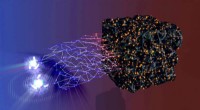
When a large, unstable nucleus absorbs a neutron, it can become even more unstable. This extra energy causes the nucleus to vibrate violently. Eventually, the electrostatic repulsion between protons overwhelms the strong force, and the nucleus splits into two smaller nuclei (fission fragments).
Important Note:
* Fissionable isotopes are specific isotopes that are particularly susceptible to fission. They often have an excess of neutrons and are large enough to be unstable.
* Neutron bombardment is commonly used to trigger fission. The neutron adds energy to the nucleus, pushing it over the edge of instability.
Let me know if you'd like more details on specific isotopes or the process of fission!