* Sodium ions (Na+)
* Bromide ions (Br-)
Here's a breakdown:
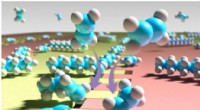
1. Dissolution: NaBr is a soluble ionic compound, meaning it has a strong attraction to water molecules. When NaBr is added to water, the water molecules surround the NaBr ions, pulling them apart from the crystal lattice.
2. Dissociation: Once the NaBr ions are separated from the crystal, they become surrounded by water molecules, forming hydrated ions. This process is called dissociation, and it results in the formation of free Na+ and Br- ions in solution.
The reaction can be represented by the following equation:
NaBr(s) → Na+(aq) + Br-(aq)
where:
* (s) indicates a solid
* (aq) indicates an aqueous solution (dissolved in water)
Key points:
* The solution becomes electrically conductive due to the presence of free ions.
* The dissociation is reversible, meaning that some Na+ and Br- ions can re-combine to form NaBr in solution. However, in a saturated solution, the equilibrium favors the dissociated form.
* The resulting solution is neutral, as neither sodium ions nor bromide ions are particularly acidic or basic.
Therefore, when sodium bromide is in water, it dissolves and dissociates into its component ions, resulting in a clear, colorless solution that conducts electricity.