Here's why:
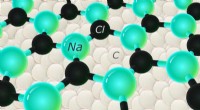
* Cleavage is the tendency of a mineral to break along specific planes of weakness within its crystal structure. Halite (NaCl) has a cubic crystal structure, meaning it breaks along three distinct planes at 90-degree angles, resulting in perfectly cubic fragments.
* Fracture is the way a mineral breaks when it doesn't have cleavage. This can result in irregular, conchoidal (shell-like), or splintery surfaces.
So, when halite breaks, it does so predictably along its cleavage planes, creating those iconic cube-shaped pieces.