Here's a breakdown:
* Chromatography is a technique used to separate mixtures based on the different affinities of the components for the stationary and mobile phases.
* Stationary phase: This is the solid or liquid phase that is fixed within the chromatography column. It can be a packed bed, a thin layer, or a membrane.
* Mobile phase: This is the liquid or gas that flows through the column and carries the sample components.
* Pressure: This is the force that pushes the mobile phase through the stationary phase.
There are several ways to generate pressure:
* Gravity: In some simple chromatography setups, gravity alone is sufficient to move the mobile phase through the stationary phase. This is called gravity-fed chromatography.
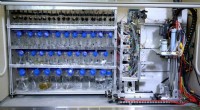
* Pump: In most modern chromatography systems, a pump is used to generate a controlled flow of the mobile phase. The pump creates pressure that forces the solution through the column.
* Gas pressure: In gas chromatography, the mobile phase is a gas, and the pressure is generated by a gas cylinder.
The pressure applied affects the speed of the separation process and the resolution of the components. Higher pressure generally leads to faster separation but can sometimes compromise resolution.