* Enthalpy change represents the difference in energy between reactants and products. It's a thermodynamic property that depends on the initial and final states of the reaction.
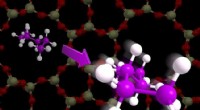
* Catalysts provide an alternative reaction pathway with a lower activation energy. They speed up the reaction by lowering the energy barrier that reactants need to overcome to form products.
* The overall energy change (ΔH) remains the same. While the catalyst lowers the activation energy, it doesn't alter the energy levels of the reactants or products. The difference in energy between them, and thus ΔH, stays constant.
Analogy:
Imagine a hill between two points, A and B. The difference in elevation between A and B represents the enthalpy change. A catalyst is like building a tunnel through the hill. The tunnel makes it easier to travel between A and B, but it doesn't change the overall elevation difference.
In summary:
* Catalysts accelerate reactions.
* Catalysts lower the activation energy.
* Catalysts do not affect the enthalpy change (ΔH) of a reaction.