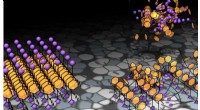
1. Increased Molecular Motion:
* The molecules in a solid are tightly packed and vibrate in fixed positions. As heat is added, these vibrations become more vigorous.
* At a specific temperature (the melting point), the vibrations become so strong that the molecules overcome the attractive forces holding them in their fixed positions.
2. Weakening of Intermolecular Forces:
* The heat energy disrupts the strong intermolecular forces (like hydrogen bonds, dipole-dipole interactions, or London dispersion forces) that hold the molecules together in a solid lattice.
* This weakening allows the molecules to move more freely and change their positions.
3. Change in Structure:
* The rigid, crystalline structure of the solid breaks down. The molecules start to move past each other and take on a less organized, more fluid arrangement.
4. Increased Entropy:
* The transition from solid to liquid increases the disorder and randomness of the system, which is known as entropy.
5. Volume Change:
* Depending on the substance, the volume may either increase or decrease during melting. For example, water expands when it freezes, but most substances contract upon melting.
6. Phase Change:
* The transition from solid to liquid is a phase change, meaning a change in the physical state of the matter. This change is usually accompanied by a change in density, viscosity, and other physical properties.
In essence, melting involves:
* Gaining energy: Heat is absorbed by the solid, increasing the kinetic energy of the molecules.
* Overcoming forces: The added energy weakens the forces holding the molecules together in a fixed structure.
* Shifting to a more disordered state: The molecules become more mobile and less organized, resulting in a liquid.