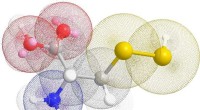
* Electrons are the key: Atoms interact with each other by sharing, donating, or accepting electrons. The nucleus (containing protons and neutrons) is generally too tightly bound and doesn't directly participate in these interactions.
* Valence electrons are the players: The valence electrons are the electrons in the outermost shell of an atom. They are the least tightly bound and therefore the most likely to be involved in chemical bonding.
* The electron cloud dictates behavior: The distribution and energy levels of the valence electrons in the electron cloud determine how an atom will bond with other atoms.
* Atoms with few valence electrons tend to lose them to achieve stability, forming positive ions.
* Atoms with many valence electrons tend to gain electrons to achieve stability, forming negative ions.
* Atoms with a moderate number of valence electrons often share electrons with other atoms, forming covalent bonds.
Examples:
* Sodium (Na): Has one valence electron. It readily loses this electron to form a Na+ ion, allowing it to interact with other atoms, like chlorine.
* Chlorine (Cl): Has seven valence electrons. It readily gains one electron to form a Cl- ion, interacting with sodium to form NaCl (table salt).
* Carbon (C): Has four valence electrons. It readily shares electrons with other atoms, forming four covalent bonds, allowing it to create complex organic molecules.
In summary, the electron cloud and specifically the valence electrons are the key players in determining how atoms interact with each other to form molecules and compounds.