Understanding the Key IR Absorptions
* Cyclohexanone (C=O): The most prominent feature in cyclohexanone's IR spectrum is a strong, sharp absorption band around 1715 cm-1 due to the carbonyl (C=O) stretching vibration.
* Cyclohexanol (O-H): Cyclohexanol will show a broad, strong absorption band in the region of 3200-3500 cm-1. This is characteristic of the O-H stretching vibration of an alcohol.
The Transformation in the IR Spectrum
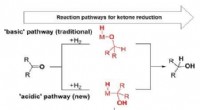
1. Disappearance of the C=O Peak: When cyclohexanone is reduced to cyclohexanol, the carbonyl group is transformed into a hydroxyl group (OH). This means the strong absorption band around 1715 cm-1 will disappear in the IR spectrum of the product.
2. Appearance of the O-H Peak: The newly formed hydroxyl group in cyclohexanol will produce a broad, strong absorption band in the region of 3200-3500 cm-1.
Important Notes
* Reaction Completion: The complete disappearance of the carbonyl peak and the appearance of the alcohol peak in the IR spectrum will indicate that the reaction has gone to completion.
* Other Peaks: The IR spectrum of cyclohexanol will also show characteristic peaks for C-H stretching and bending vibrations, but these are not as specific to the reaction.
In Summary
IR spectroscopy can be used to confirm the conversion of cyclohexanone to cyclohexanol by observing:
* Disappearance of the carbonyl (C=O) absorption peak at around 1715 cm-1.
* Appearance of the hydroxyl (O-H) absorption peak in the range of 3200-3500 cm-1.
This provides strong evidence for the successful reduction reaction.