Here's a breakdown:
* Kinetic Energy: This is the energy of motion. The higher the temperature, the more kinetic energy the particles have, and the faster they move.
* Attractive Forces: These are forces that hold the particles together. They can be due to various interactions, like hydrogen bonding, dipole-dipole forces, or London dispersion forces.
Let's look at each phase in more detail:
Solid:
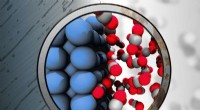
* Strong attractive forces: The particles are tightly packed and held together by strong attractive forces.
* Low kinetic energy: The particles vibrate in fixed positions, but they don't have enough energy to overcome the attractive forces and move freely.
* Fixed shape and volume: Solids have a definite shape and volume because the particles are locked in a rigid structure.
Liquid:
* Moderate attractive forces: The particles are closer together than in a gas, but they can still move around each other.
* Moderate kinetic energy: The particles have enough energy to overcome some of the attractive forces, allowing them to move past each other.
* Fixed volume but not shape: Liquids take the shape of their container but maintain a fixed volume.
Gas:
* Weak attractive forces: The particles are far apart and have very weak attractive forces between them.
* High kinetic energy: The particles move very rapidly and randomly, colliding with each other and the walls of their container.
* No fixed shape or volume: Gases take the shape and volume of their container because the particles are constantly moving and spread out.
Phase Changes:
Changes in temperature and pressure affect the balance between kinetic energy and attractive forces, leading to phase changes:
* Heating: Increases kinetic energy, making it easier for particles to overcome attractive forces and transition to a less ordered state (solid to liquid, liquid to gas).
* Cooling: Decreases kinetic energy, making it more likely for attractive forces to dominate and particles to transition to a more ordered state (gas to liquid, liquid to solid).
* Increasing pressure: Forces particles closer together, increasing the influence of attractive forces and favoring a more condensed state (gas to liquid, liquid to solid).
* Decreasing pressure: Allows particles to move farther apart, weakening the attractive forces and favoring a more expanded state (solid to liquid, liquid to gas).
In summary, the phase of a substance is determined by the delicate balance between the forces holding its particles together and the energy they possess. Changes in temperature and pressure can shift this balance, leading to transitions between solid, liquid, and gaseous states.