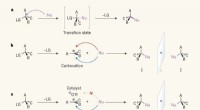
* Activation Energy: This is the minimum amount of energy that reactant molecules must possess in order to collide and form products.
* Catalyst's Role: A catalyst provides an alternative reaction pathway with a lower activation energy. This means that more reactant molecules will have enough energy to overcome the activation barrier and react.
* Increased Collision Effectiveness: While a catalyst doesn't change the overall energy difference between reactants and products (the enthalpy change), it makes the collisions between reactant molecules more effective, leading to a higher rate of successful reactions.
In simpler terms: Think of a hill that molecules need to climb to react. A catalyst provides a ramp or tunnel that makes it easier for molecules to get over the hill, allowing them to react faster.
Here are some key points to remember about catalysts and collision theory:
* Catalysts are not consumed in the reaction: They participate in the reaction but are regenerated at the end.
* Catalysts can be specific: They often work for a particular reaction or type of reaction.
* Catalysts speed up both the forward and reverse reactions: This means they help the reaction reach equilibrium faster, but don't change the equilibrium position.
Let me know if you have any more questions about collision theory or catalysts!