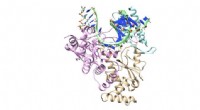
1. Activation of the amino acid:
* Reaction: Amino acid + ATP → Aminoacyl-AMP + PPi (pyrophosphate)
* Description: The aaRS first binds both the specific amino acid and ATP. ATP provides the energy for the reaction. The amino acid is then attached to the AMP molecule, forming an aminoacyl-AMP intermediate, while releasing pyrophosphate (PPi).
2. Transfer of the amino acid to tRNA:
* Reaction: Aminoacyl-AMP + tRNA → Aminoacyl-tRNA + AMP
* Description: The aaRS then binds the specific tRNA corresponding to the amino acid it is carrying. The aminoacyl-AMP intermediate is then transferred from the aaRS to the 3' end of the tRNA, attaching the amino acid to the tRNA. AMP is released as a byproduct.
Overall reaction:
Amino acid + ATP + tRNA → Aminoacyl-tRNA + AMP + PPi
Specificity of the reaction:
Each aaRS is highly specific for both a particular amino acid and its corresponding tRNA. This ensures that the correct amino acid is attached to the correct tRNA, ensuring accurate protein synthesis.
Key points to remember:
* The process is highly specific and requires an aaRS for each amino acid.
* The reaction is driven by the hydrolysis of ATP, which provides energy for the reaction.
* The aminoacyl-tRNA complex is ready to participate in protein synthesis.
Therefore, the reactions required to generate an aminoacyl tRNA involve the activation of the amino acid with ATP, followed by the transfer of the activated amino acid to the corresponding tRNA by the specific aaRS.