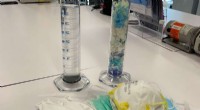
* Increased surface area: When you crush a solid, you break it into smaller pieces. This increases the surface area of the solid that is exposed to the solvent. Imagine a sugar cube. It only has a few sides exposed to water. But crush it, and you have many more tiny pieces, all with exposed surfaces that can interact with the water molecules.
* More contact points: With increased surface area, there are more contact points between the solute and the solvent. This allows the solvent molecules to surround and interact with the solute molecules more effectively, aiding in the dissolving process.
* Faster diffusion: The smaller particles created by crushing are more easily moved around by the solvent molecules. This helps the dissolved solute to spread out and distribute evenly throughout the solution, further promoting dissolving.
In simpler terms: Think of it like eating a cookie. You can eat a whole cookie, but it takes longer to break it down. Crushing it into smaller pieces lets you eat it faster because there's more surface area for your saliva to interact with.
However, it's important to note that crushing does not change the solubility of the solute. It just makes the dissolving process happen faster. The amount of solute that dissolves in a given amount of solvent at a specific temperature remains the same.