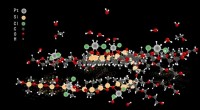
However, some molecules are much more resistant to change than others. Here are a few examples:
* Noble gases: These elements (Helium, Neon, Argon, Krypton, Xenon, Radon) exist as single atoms and are very unreactive. They rarely form bonds with other atoms.
* Certain inorganic compounds: Some very stable compounds like salt (NaCl) and diamond (carbon) are resistant to decomposition under normal conditions.
* Large, complex molecules: Some large molecules like proteins can be incredibly complex and stable, with a very specific structure. They can undergo subtle changes, but their overall structure can remain remarkably stable.
Here's why it's important to understand:
* Change is the nature of matter: Even stable molecules can undergo transformations under the right conditions (temperature, pressure, presence of other molecules, etc.).
* Understanding stability: Understanding the factors that contribute to the stability of molecules is crucial in many fields, from chemistry and biology to materials science and medicine.
So, while there's no molecule that is completely unchanging, understanding the relative stability of different molecules is important for various scientific disciplines.