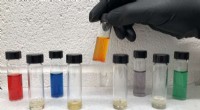
Color: This is one of the most noticeable properties of a compound. It is the way the compound reflects or absorbs light, and can be described using color names (e.g., red, blue, green), shades (e.g., light red, dark blue), or hues (e.g., reddish-orange, bluish-green).
Texture: Texture describes the surface characteristics of a compound, including its smoothness, roughness, graininess, or other tactile qualities. It can be felt by touching the compound or observed visually.
Shape: Shape refers to the overall geometric form or structure of a compound. It can be described using terms like solid, liquid, gas, crystal, powder, or any other specific shapes such as cubes, spheres, rods, etc.
Luster: Luster describes how a compound reflects light. It can be classified as metallic (shiny like metal), dull (lacking shine), or pearly (exhibiting a shiny, iridescent sheen).
Opacity: Opacity refers to the degree to which a compound allows light to pass through. It can be transparent (allowing light to pass through clearly), translucent (partially allowing light to pass through but not clearly), or opaque (blocking light from passing through).
Crystal Structure: In the case of crystalline solids, the appearance can also include the description of the crystal structure. This refers to the regular arrangement of atoms, molecules, or ions in a crystal lattice. The crystal structure can be determined using various techniques such as X-ray crystallography.
It's important to note that the appearance of a compound can vary depending on factors such as its purity, crystal size, temperature, and other conditions. Therefore, it is always recommended to refer to specific experimental observations or scientific literature to accurately describe the appearance of a compound.