- Test for Hydrogen Peroxide (H2O2):
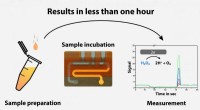
When sodium peroxoborate is treated with sulfuric acid (H2SO4), it releases hydrogen peroxide. Hydrogen peroxide can be detected by adding potassium iodide (KI) to the solution. The reaction between H2O2 and KI produces iodine (I2), which can be observed as a brown-orange color or yellow precipitate.
2H2O2 + 2KI + H2SO4 → 2H2O + I2 + 2KHSO4
The presence of a brown-orange color or yellow precipitate indicates the presence of hydrogen peroxide in sodium peroxoborate.
- Test for Perborate (BO3)^- ions:
Perborate ions can be detected by adding a few drops of sulfuric acid to sodium peroxoborate solution. Upon acidification, perborate ions release hydrogen peroxide (H2O2) and boric acid (H3BO3). Boric acid reacts with sulfuric acid to form a boric acid-sulfuric acid complex, which can be detected by using turmeric paper. When turmeric paper is dipped into the solution, it turns reddish-brown in the presence of boric acid.
NaBO3 + H2SO4 + H2O → H2O2 + H3BO3 + NaHSO4
H3BO3 + H2SO4 → B(OH)3·H2SO4
The change in color of turmeric paper to reddish-brown confirms the presence of perborate ions in sodium peroxoborate.
These tests provide a simple and convenient way to identify and confirm the presence of hydrogen peroxide and perborate ions in sodium peroxoborate, which is crucial for quality control and analysis of this compound.