1. Increased Kinetic Energy: As the temperature of a solid increases, the particles gain more kinetic energy. This means that they move faster and vibrate more vigorously within their fixed positions in the lattice structure.
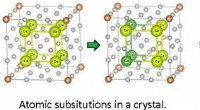
2. Lattice Vibrations: The increased kinetic energy leads to stronger and more frequent vibrations of the particles around their equilibrium positions. The lattice structure of the solid starts to expand due to these intensified vibrations.
3. Occupying Larger Volumes: As the particles vibrate more vigorously, they tend to occupy slightly larger volumes. The bonds between the particles become weaker, providing them with the necessary freedom to move further apart without completely breaking the crystalline structure.
4. Linear Expansion: The expansion of a solid is typically uniform in all directions. This means that the length, width, and height of the solid increase proportionally. The amount of expansion is directly related to the temperature increase and is expressed by the linear expansion coefficient, which is a material-specific property.
5. Preservation of Crystalline Structure: Unlike liquids or gases, solids maintain their crystalline structure even during expansion. The particles still occupy lattice positions but with increased spacing between them. The structure and shape of the solid remain essentially unchanged, only larger in size.
6. Thermal Expansion: The expansion of a solid due to temperature increases is known as thermal expansion. Different materials exhibit different coefficients of thermal expansion, indicating their varying degrees of expansion in response to temperature changes.
In summary, particles in an expansion of a solid experience increased kinetic energy and intensified vibrations within the lattice structure. They occupy larger volumes while maintaining their crystalline arrangement, leading to an overall increase in the dimensions of the solid.