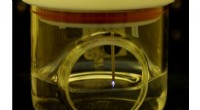
1. Gather the necessary materials: a graduated cylinder or hydrometer, a balance or scale, and the liquid you want to measure.
2. Weigh the empty graduated cylinder or hydrometer. Record this weight as W1.
3. Fill the graduated cylinder or hydrometer with the liquid to be measured. Record the volume of the liquid as V1.
4. Weigh the graduated cylinder or hydrometer with the liquid. Record this weight as W2.
5. Calculate the mass of the liquid by subtracting the weight of the empty graduated cylinder or hydrometer (W1) from the weight of the graduated cylinder or hydrometer with the liquid (W2). Record this value as M.
6. Calculate the relative density of the liquid by dividing the mass of the liquid (M) by the volume of the liquid (V1). The relative density will be a dimensionless number.
Here is the formula for calculating relative density:
Relative density = Mass of liquid / Volume of liquid
Relative density is also known as specific gravity, and it represents the ratio of the density of a liquid to the density of water at 4 degrees Celsius. A relative density of 1 means that the liquid has the same density as water, while a relative density greater than 1 means that the liquid is denser than water and a relative density less than 1 means that the liquid is less dense than water.