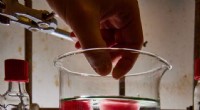
As the particles escape from the surface, they spread out and occupy a larger volume. This is because the gas phase is less dense than the liquid phase. The particles also become more energetic as they move faster and have more kinetic energy.
The rate of evaporation depends on a number of factors, including the temperature of the liquid, the surface area of the liquid, and the surrounding environment. The higher the temperature, the more energy the particles have and the faster they will evaporate. The larger the surface area, the more particles there are available to evaporate. And the drier the surrounding environment, the more water vapor it can hold and the faster the evaporation will occur.
Evaporation is an important process in the water cycle. It is the process by which liquid water is converted into water vapor and rises into the atmosphere. This water vapor eventually condenses into clouds and falls as precipitation.