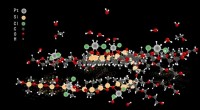
The cell membrane is a phospholipid bilayer, which means that it is made up of two layers of phospholipids. Phospholipids are molecules that have a hydrophilic (water-loving) head and a hydrophobic (water-hating) tail. The hydrophilic heads face outward, where they interact with water, and the hydrophobic tails face inward, where they interact with each other.
Lipid soluble molecules are molecules that can dissolve in lipids. This means that they can interact with the hydrophobic tails of the phospholipids in the cell membrane. Water molecules, on the other hand, cannot dissolve in lipids. This means that they cannot interact with the hydrophobic tails of the phospholipids in the cell membrane.
Because lipid soluble molecules can interact with the hydrophobic tails of the phospholipids in the cell membrane, they can diffuse into the cell more rapidly than water molecules. Water molecules must pass through the hydrophilic heads of the phospholipids in order to enter the cell, which is a slower process.