We can use Lambert-Beer's law to find out the concentration of a colored solution without titration or colorimetry by measuring the absorbance of the solution at a specific wavelength. The wavelength of light that is absorbed will depend on the color of the solution.
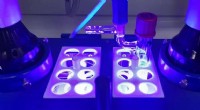
To measure the absorbance of a solution, we can use a spectrophotometer. A spectrophotometer is a device that measures the amount of light that is absorbed by a solution at a specific wavelength.
The absorbance of a solution is calculated using the following equation:
```
A = log(I0/I)
```
Where:
* A is the absorbance of the solution
* I0 is the intensity of the light before it passes through the solution
* I is the intensity of the light after it passes through the solution
The concentration of a solution can be calculated using Lambert-Beer's law and the absorbance of the solution at a specific wavelength. The following equation can be used to calculate the concentration of a solution:
```
c = A/εb
```
Where:
* c is the concentration of the solution in mol/L
* A is the absorbance of the solution
* ε is the molar absorptivity of the absorbing species in L/mol·cm
* b is the pathlength of the solution in cm
The molar absorptivity of an absorbing species is a measure of how strongly it absorbs light at a specific wavelength. The molar absorptivity of a substance can be found in the literature.
By measuring the absorbance of a solution at a specific wavelength and using Lambert-Beer's law, we can find out the concentration of a colored solution without titration or colorimetry.