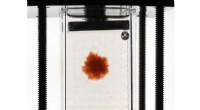
A homogeneous mixture is a mixture in which the components are evenly distributed throughout the mixture and the composition is uniform throughout. On the other hand, a heterogeneous mixture is a mixture in which the components are not evenly distributed and the composition varies from one part of the mixture to another.
In the case of potassium chloride and water, potassium chloride is a solid that dissolves in water to form a solution. The solute particles (potassium and chloride ions) are evenly distributed throughout the solvent (water), forming a homogeneous mixture at the molecular level. However, if you observe the mixture as a whole, you can see that there are two distinct phases: a liquid phase (the solution) and a solid phase (undissolved potassium chloride). Therefore, potassium chloride and water is a heterogeneous mixture at the macroscopic level.