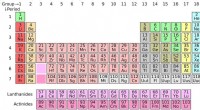
The periodic table is arranged so that the elements in each group have similar chemical properties. For example, all of the alkali metals (Group 1) are highly reactive and have one valence electron. All of the halogens (Group 7) are highly reactive and have seven valence electrons.
The groups in the periodic table are numbered 1-18 from left to right. The groups are also divided into two categories: main group elements and transition metals. The main group elements are the elements in Groups 1, 2, 13-18. The transition metals are the elements in Groups 3-12.
The main group elements are further divided into three categories: metals, nonmetals, and metalloids. Metals are elements that are shiny, malleable, and ductile. Nonmetals are elements that are not shiny, are not malleable or ductile, and are poor conductors of heat and electricity. Metalloids are elements that have properties of both metals and nonmetals.
The transition metals are all metals, but they have a wider range of properties than the main group metals. Transition metals are generally hard, strong, and have high melting points. They are also good conductors of heat and electricity.
The periodic table is a valuable tool for understanding the properties of elements and how they interact with each other. By understanding the groups and categories of elements, you can better understand the behavior of matter.