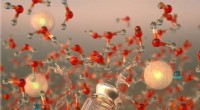
Nuclear fission is a nuclear reaction in which a heavy atomic nucleus is split into two or more smaller nuclei. This process releases a great amount of energy, which can be used to generate electricity.
One example of nuclear fission is the reaction of uranium-235 with a neutron. This reaction produces two smaller nuclei, krypton-92 and barium-141, as well as two neutrons and a great amount of energy. The neutrons released from this reaction can then go on to split other uranium-235 nuclei, creating a chain reaction that can sustain itself and produce a continuous source of energy.
$$^{235}U + n \rightarrow ^{92}Kr + ^{141}Ba + 2n + energy$$
Nuclear fusion
Nuclear fusion is a nuclear reaction in which two or more atomic nuclei are combined to form a single, heavier nucleus. This process also releases a great amount of energy, which can be used to generate electricity.
One example of nuclear fusion is the reaction of deuterium and tritium, two isotopes of hydrogen. This reaction produces helium-4 and a neutron, as well as a great amount of energy.
$$^2H + ^3H \rightarrow ^4He + n + energy$$
Nuclear fusion is the process that powers the sun and other stars. It is also the process that is used in thermonuclear weapons, such as the hydrogen bomb.