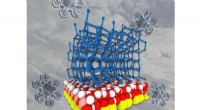
Here's a deeper explanation of hydrogen bonding in water:
1. Polarity of Water Molecules:
• Water molecules are polar molecules, meaning they have a partial positive charge on the hydrogen atoms and a partial negative charge on the oxygen atom.
• This polarity arises because oxygen has a higher electronegativity than hydrogen, pulling the shared electrons in the O-H bond closer to itself. As a result, the oxygen atom has a higher electron density and becomes slightly negative, while the hydrogen atom becomes slightly positive.
2. Hydrogen Bonding Formation:
• The slightly positive hydrogen atom of one water molecule is attracted to the slightly negative oxygen atom of another water molecule.
• This attraction leads to the formation of a hydrogen bond, a strong intermolecular force that holds the two water molecules together.
3. Multiple Hydrogen Bonds:
• Each water molecule can form hydrogen bonds with up to four other water molecules due to its tetrahedral shape and the orientation of its hydrogen and oxygen atoms.
• This ability to form multiple hydrogen bonds is responsible for water's unique properties, such as its high surface tension, specific heat capacity, and boiling point.
4. Strength of Hydrogen Bonds:
• Hydrogen bonds are not as strong as covalent bonds but are stronger than other intermolecular forces such as van der Waals forces.
• The strength of the hydrogen bond in water is influenced by the electronegativity difference between oxygen and hydrogen and the extent of charge separation within the molecule.
In summary, hydrogen bonds form between water molecules due to the polar nature of the water molecule, enabling the slightly positive hydrogen atom to be attracted to the slightly negative oxygen atom. These hydrogen bonds are responsible for many of water's unique properties and play a crucial role in its behavior and interactions with other substances.