1. Create a container:
- Begin by drawing a container, such as a beaker or flask, to represent the space where condensation will occur.
2. Label the container:
- Clearly label the container as "Container" or "Flask."
3. Draw water droplets:
- Inside the container, draw small, scattered water droplets to represent the water vapor.
4. Label water droplets:
- Label the water droplets as "Water Vapor."
5. Draw a temperature gradient:
- On one side of the container, draw a heat source, such as a flame, to indicate a higher temperature.
- On the opposite side, draw the outside environment represented by cooler air, indicating a lower temperature.
6. Show the temperature difference:
- Use arrows to indicate the direction of heat transfer, with the heat moving from the higher temperature (heat source) to the lower temperature (cooler air).
7. Draw condensed water:
- On the cooler side of the container, draw a layer of condensed water droplets merging together.
8. Label condensed water:
- Label this layer as "Condensed Water."
9. Show the direction of condensation:
- Draw arrows pointing downward from the water vapor droplets towards the condensed water to indicate the process of condensation.
10. Provide a caption:
- Add a caption below the diagram stating, "Diagram of the Condensation Process."
11. Finalize the diagram:
- Clean up any rough lines, making sure the diagram is neat and easy to understand.
12. Add additional details (optional):
- You can include labels for the states of water (gas, liquid, and solid) within the diagram for further clarification.
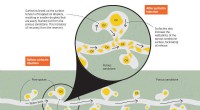
Your diagram should now visually represent the process of condensation, where water vapor in the container cools down, turns into liquid water droplets, and accumulates as condensed water.