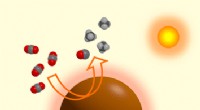
Balanced Equations: Chemical equations must be balanced to ensure that the number of atoms of each element is the same on both sides of the equation. Balancing equations can be challenging, especially for complex reactions involving multiple reactants and products.
Reactant and Product Specificity: Chemical equations only provide information about the starting materials (reactants) and the final products of a reaction. They do not provide details about the reaction pathway or the intermediates formed during the reaction.
Stoichiometry: Chemical equations provide information about the stoichiometry of a reaction, which refers to the quantitative relationship between reactants and products. However, they do not provide information about the rate or kinetics of a reaction, which determine how fast the reaction occurs.
Energy Changes: Chemical equations do not explicitly show energy changes that occur during a reaction. Thermochemical equations can be used to represent enthalpy changes associated with reactions, but they are separate from standard chemical equations.
Reaction Conditions: Chemical equations typically do not specify the conditions under which a reaction takes place, such as temperature, pressure, or the presence of a catalyst. These factors can significantly influence the outcome of a reaction.
Real-World Complexity: Chemical equations represent simplified representations of reactions that occur in a controlled environment. In real-world scenarios, reactions can be influenced by various factors such as impurities, side reactions, and the presence of other substances, making it challenging to accurately predict outcomes based solely on chemical equations.
Quantum Effects: Chemical equations based on classical chemical concepts may not accurately describe reactions involving quantum effects, such as those occurring at very low temperatures or with subatomic particles.
Despite these limitations, chemical equations remain an essential tool for understanding and representing chemical reactions. They provide a concise and systematic way to communicate chemical transformations and perform stoichiometric calculations. However, it is important to be aware of the limitations and use chemical equations in conjunction with other information to gain a complete understanding of chemical reactions and processes.