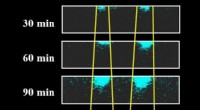
For example, when a person opens a bottle of perfume in one corner of a room, the perfume molecules will rapidly diffuse throughout the room. The perfume molecules will move from the area of higher concentration (the bottle) to the areas of lower concentration (the rest of the room). This process will continue until the perfume molecules are evenly distributed throughout the room.
Diffusion is a passive process, meaning that it does not require energy input. It is driven by the natural tendency of molecules to move from areas of higher concentration to areas of lower concentration.
The rate of diffusion is determined by several factors, including the concentration gradient (the difference in concentration between two areas), the temperature, and the size of the molecules. The higher the concentration gradient, the faster the rate of diffusion. The higher the temperature, the faster the rate of diffusion. And the smaller the molecules, the faster the rate of diffusion.
Diffusion is an important process in biology. It is responsible for the movement of molecules into and out of cells. It also plays a role in the transport of nutrients and gases in the body.