1. Dissociation: The water molecules are split into their component elements: hydrogen (H2) and oxygen (O2). This process is known as electrolysis of water.
2. Formation of Hydrogen Gas: At the cathode (negative electrode), hydrogen ions (H+) from water molecules are attracted to the electrode and gain electrons to become hydrogen gas (H2). The hydrogen atoms then combine to form hydrogen molecules.
3. Formation of Oxygen Gas: At the anode (positive electrode), water molecules undergo a different reaction. Here, hydroxide ions (OH-) from the water lose electrons, causing the oxygen atoms to combine into oxygen gas (O2). These oxygen atoms form oxygen molecules (O2) and are released from the anode.
4. Electrolyte: To facilitate the electrolysis process, an electrolyte is usually added to the water. This electrolyte can be an acid, a base, or a salt, and its presence helps enhance the conductivity of the water and increases the efficiency of the electrolysis process.
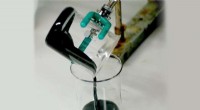
5. Bubbles: As electrolysis continues, bubbles of hydrogen and oxygen gas are produced at the respective electrodes and rise to the surface of the water. The hydrogen bubbles collect at the cathode while the oxygen bubbles collect at the anode.
The overall chemical reaction for the electrolysis of water can be represented as follows:
2H2O(l) → 2H2(g) + O2(g)
In summary, when an electric current is passed through water during electrolysis, the water molecules dissociate into hydrogen and oxygen gases. Hydrogen gas is produced at the cathode, and oxygen gas is produced at the anode. These gases can then be collected and used for various applications.