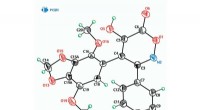
1. NADP+ Reduction: Initially, NADP exists in its oxidized form, abbreviated as NADP+. When it accepts an electron, it is reduced to NADPH.
2. Gain of Hydride Ion (H-): The addition of an electron to NADP+ is accompanied by the transfer of a hydrogen ion (H+) and two electrons. One of the electrons is used to reduce the positively charged nitrogen atom in the nicotinamide ring, while the other electron, along with the hydrogen ion, forms a hydride ion (H-).
3. Formation of NADPH: The reduced form of NADP, now known as NADPH, carries the newly acquired hydride ion (H-) and has a negative charge.
The overall reaction can be represented as:
NADP+ + 2e- + H+ → NADPH + H+
In summary, when an electron is passed to NADP, it becomes reduced to NADPH, gaining a hydride ion (H-) and undergoing a change in its oxidation state. NADPH then acts as a carrier of reducing equivalents (electrons and hydrogen ions) in various biochemical reactions.