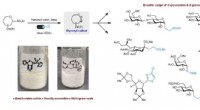
- In a glycosidic linkage, the two functional groups are a hydroxyl group from a sugar and an anomeric carbon from another sugar.
- In a peptide bond, the two functional groups are an amino group from an amino acid and a carboxyl group from another amino acid.
Additionally, both glycosidic linkages and peptide bonds have a specific stereochemistry.
* Glycosidic linkages can be either α or β, depending on the relative orientation of the two sugar rings.
* Peptide bonds are always formed in the trans configuration, with the amino and carboxyl groups on opposite sides of the peptide bond.
Finally, both glycosidic linkages and peptide bonds are involved in the formation of important biological molecules.
- Glycosidic linkages are found in carbohydrates, which are an essential source of energy for cells.
- Peptide bonds are found in proteins, which are responsible for a wide range of cellular functions.