1. Vacancy Diffusion: In crystalline solids, diffusion can occur through the movement of vacant lattice sites, also known as vacancies. Atoms or ions adjacent to a vacancy can move into the vacancy, effectively "hopping" to a new position in the lattice. This mechanism is common in metals and simple ionic crystals.
2. Interstitial Diffusion: In solids with interstitial sites, which are spaces between atoms or ions in the lattice, diffusion can occur through the movement of small atoms or ions into these interstitial sites. This mechanism is often observed in alloys and interstitial compounds.
3. Dislocation Diffusion: Dislocations are defects in the crystal lattice where atoms are misaligned. Diffusion along dislocations can be much faster than diffusion through the regular lattice because dislocations provide a pathway for atoms to move more easily. This mechanism is particularly important in plastic deformation and creep of solids.
4. Surface Diffusion: Diffusion can also occur on the surface of solids. Surface atoms or ions have higher mobility due to the absence of constraints from neighboring atoms in the bulk. Surface diffusion is often involved in surface processes such as crystal growth, thin-film formation, and sintering.
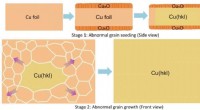
5. Grain Boundary Diffusion: In polycrystalline solids, grain boundaries are interfaces between different crystal grains with different orientations. Diffusion along grain boundaries can be enhanced due to the structural disorder and higher mobility of atoms at these interfaces. Grain boundary diffusion plays a crucial role in various processes such as grain growth, recrystallization, and phase transformations.
The rate of diffusion in solids is typically influenced by several factors, including temperature, the concentration gradient of the diffusing species, the crystal structure, and the presence of defects or impurities. Higher temperatures generally increase the diffusion rate, while the presence of obstacles or complex crystal structures can hinder diffusion.