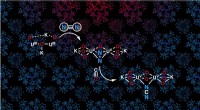
Due to the continuous motion of electrons, instantaneous dipoles can be created when the electron cloud shifts in one direction. These transient dipoles can then induce a similar dipole in neighboring molecules, leading to an attractive force between them. This fluctuating dipole-dipole interaction is known as London dispersion force and is the dominant intermolecular force present in bromine.
London dispersion forces are relatively weak compared to other types of intermolecular forces such as hydrogen bonding, but they become more significant as the number of electrons and molecular weight of the molecule increases. In the case of bromine, being a relatively heavy diatomic molecule, London dispersion forces play a crucial role in holding the liquid molecules together.