Title: How Superhydrophobic Materials Stay Totally Dry
[Opening shot: A water droplet forms and then rolls off of a superhydrophobic surface.]
Narrator: Superhydrophobic materials are surfaces that repel water so effectively that water droplets form nearly perfect spheres and roll off without leaving a trace. This is in stark contrast to regular surfaces, where water droplets tend to spread out and stick.
So, how do superhydrophobic materials achieve this amazing feat of dryness?
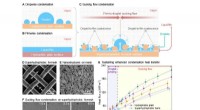
[Cut to a close-up of a superhydrophobic surface. The surface is covered in tiny pillars, each of which is about the size of a bacterium. The pillars are so small that they trap air pockets between them. When a water droplet comes into contact with the surface, it rests on these air pockets instead of the surface itself. This creates a barrier that prevents the water from spreading out and sticking.]
Narrator: The key to superhydrophobicity is the combination of two factors: the nanoscale roughness of the surface and the presence of air pockets. The roughness prevents the water from wetting the surface, while the air pockets provide a cushion that keeps the water droplets from sticking.
[Cut to a shot of a person holding a superhydrophobic umbrella. The umbrella is completely dry, even though it is raining heavily.]
Narrator: Superhydrophobic materials have a wide range of potential applications, including self-cleaning surfaces, waterproof clothing, and anti-fogging coatings. They are also being explored for use in medical devices, such as catheters and implants, where it is important to prevent the build-up of bacteria and other contaminants.
As research continues, we can expect to see even more innovative and groundbreaking applications for these remarkable materials.
[Closing shot: A superhydrophobic surface sheds water droplets like a lotus leaf.]