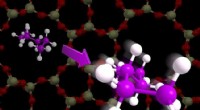
Electron solvation, the process by which electrons interact with water molecules, has been studied using advanced spectroscopic techniques. These techniques allow scientists to observe the dynamics of electrons in real-time. The findings suggest that electrons behave like "cagey" particles, exhibiting both localized and delocalized characteristics.
Key observations include:
- Electrons form transient clusters with water molecules, creating "electron-water clusters."
- These clusters are not static but rather undergo constant rearrangements, resembling a "flickering" or "dancing" motion.
- The electron-water clusters exhibit a "cage-like" structure, where water molecules act as a protective shield around the electron.
- The "cagey" behavior of electrons is influenced by temperature and the surrounding environment.
The research team led by Professor Majed Chergui from the École Polytechnique Fédérale de Lausanne (EPFL) utilized X-rays to probe the dynamics of hydrated electrons in water clusters. Their findings provide direct experimental evidence for the "cagey" nature of electrons and contribute to a deeper understanding of electron behavior in aqueous environments.
Comprehending the behavior of hydrated electrons is crucial because these species play a vital role in various chemical and biological processes, including photosynthesis, energy storage, and radiation chemistry. The insights gained from this research could have implications in fields such as electrochemistry, catalysis, and the development of technologies that harness the power of hydrated electrons.