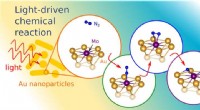
Researchers at the University of Nottingham have made a breakthrough in understanding how chemical reactions work, which could lead to the development of new drugs and materials.
The team, led by Professor David Glowacki, used a technique called 'ultrafast spectroscopy' to track the movements of atoms and molecules during a chemical reaction in real time. This allowed them to see how the reaction takes place at the atomic level, which has never been possible before.
The findings, published in the journal Nature Chemistry, could have a major impact on a wide range of fields, including medicine, materials science, and energy research.
Professor Glowacki said: "We are very excited about these findings. They provide a new way of understanding how chemical reactions work, which could lead to the development of new drugs, materials, and energy sources.
"For example, we could use this knowledge to design drugs that are more effective and have fewer side effects. We could also develop new materials that are stronger, lighter, and more durable. And we could even develop new ways to generate energy that are more efficient and environmentally friendly."
The research was funded by the Engineering and Physical Sciences Research Council (EPSRC).
How does ultrafast spectroscopy work?
Ultrafast spectroscopy is a technique that uses very short pulses of light to excite molecules. This allows researchers to track the movements of atoms and molecules during a chemical reaction in real time.
The pulses of light are so short that they can excite molecules without disturbing them. This means that researchers can see how the reaction takes place without interfering with it.
What are the implications of this research?
The findings of this research could have a major impact on a wide range of fields, including medicine, materials science, and energy research.
For example, researchers could use this knowledge to design drugs that are more effective and have fewer side effects. They could also develop new materials that are stronger, lighter, and more durable. And they could even develop new ways to generate energy that are more efficient and environmentally friendly.
This research is still in its early stages, but it has the potential to revolutionize the way we think about chemical reactions. It could lead to the development of new technologies that will benefit us all.