Ordinarily, superconductors and magnets don't get along. Superconductors hate magnetic fields, and magnets disrupt the delicate quantum dance of electrons that gives rise to superconductivity. But CeCoIn5 defies expectations. It's a superconductor, yet it also hosts magnetic moments within its atomic lattice.
The magnetic moments in CeCoIn5 are not static. Instead, they dance, creating a sea of fluctuating magnetism. These magnetic fluctuations, rather than disrupting superconductivity, seem to enhance it. The superconducting dome in CeCoIn5—the range of temperatures and magnetic fields where superconductivity occurs—is anomalously large, extending much further than theoretical predictions based on conventional theories.
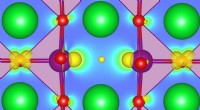
Researchers believe that the key to understanding this unusual behavior lies in the interplay between the conduction electrons that carry the supercurrent and the localized 4f electrons that give rise to the magnetic moments. These two types of electrons interact via a subtle quantum effect called the Ruderman-Kittel-Kasuya-Yosida (RKKY) interaction.
The RKKY interaction is a long-range magnetic interaction mediated by the conduction electrons. In CeCoIn5, the RKKY interaction leads to the formation of magnetic "hotspots," regions where the magnetic fluctuations are particularly strong. These hotspots act as nucleation centers for the superconducting pairs, promoting superconductivity.
The interplay between superconductivity and magnetism in CeCoIn5 is a delicate one. Too much magnetism can suppress superconductivity, while too little magnetism can prevent superconductivity from emerging. But when the balance is just right, the magnetic fluctuations enhance superconductivity, pushing the boundaries of what we thought was possible.
CeCoIn5 is a material that continues to surprise and challenge our understanding of superconductivity. By unraveling its secrets, we gain valuable insights into the complex interplay between these two fundamental physical phenomena, opening new avenues for the exploration and development of novel superconducting materials.