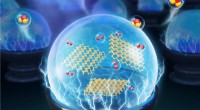
Scientists have captured the first direct observation of a proton escaping from a molecule during a chemical reaction. The observation was made using a technique called ultrafast electron diffraction (UED), which allowed the researchers to track the motion of atoms in real time.
The study, published in the journal Science, provides new insights into how chemical bonds break and form. This fundamental understanding could lead to the development of new drugs, catalysts, and other materials.
In a chemical reaction, bonds between atoms are broken and new bonds are formed. This process can be very fast, happening on the order of femtoseconds (one quadrillionth of a second). UED is one of the few techniques that can capture the dynamics of chemical reactions at this ultrafast timescale.
In the study, the researchers used UED to track the motion of atoms in a molecule of methane (CH4). They found that when the molecule was exposed to a high-energy laser pulse, a proton (H+) was ejected from the molecule. This process occurred within 10 femtoseconds.
The researchers were able to reconstruct a detailed molecular movie of the reaction. The movie shows the proton escaping from the molecule and the remaining atoms rearranging themselves to form a new molecule.
This study provides the first direct observation of a proton escaping from a molecule during a chemical reaction. This fundamental understanding could lead to the development of new drugs, catalysts, and other materials.
More details about the study:
* The study was led by researchers at the SLAC National Accelerator Laboratory in Menlo Park, California.
* The researchers used the Linac Coherent Light Source (LCLS), a powerful X-ray laser, to generate the high-energy laser pulses that were used to initiate the chemical reaction.
* The UED measurements were made using a special detector called a streak camera. The streak camera allowed the researchers to track the motion of atoms in real time.
Potential applications of this research:
* The fundamental understanding of how chemical bonds break and form could lead to the development of new drugs, catalysts, and other materials.
* For example, the researchers believe that the insights gained from this study could be used to design new drugs that are more effective and have fewer side effects.
* The study could also lead to the development of new catalysts, which are substances that speed up chemical reactions. This could make it possible to produce chemicals more efficiently and with less waste.