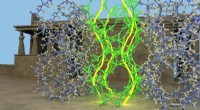
Crystalline sponges, a class of porous materials, have gained significant attention in the scientific community due to their unique ability to selectively capture and release guest molecules. Understanding the mechanism by which these sponges release water molecules is crucial for optimizing their performance and exploring potential applications. This blog post delves into the intricate dance of hydrophilic and hydrophobic interactions that governs the release of water molecules from crystalline sponges.
The Role of Hydrophilic and Hydrophobic Forces
Crystalline sponges are composed of a network of interconnected channels and cavities lined with functional groups. These functional groups can be either hydrophilic (water-attracting) or hydrophobic (water-repelling). The interplay between these hydrophilic and hydrophobic interactions drives the adsorption and desorption of water molecules within the sponge's pores.
Adsorption of Water Molecules
Initially, when a crystalline sponge comes into contact with water, the hydrophilic groups on the inner surfaces of the channels and cavities strongly interact with water molecules, forming hydrogen bonds. These hydrogen bonds create a favorable environment for water adsorption, leading to the initial uptake of water molecules into the sponge's pores.
Desorption of Water Molecules
As more water molecules are adsorbed into the sponge, the concentration of water molecules inside the pores increases. This increase in concentration creates competition between water molecules for the limited number of hydrophilic sites. As a result, some water molecules lose their hydrogen bonds with the hydrophilic groups and become more loosely bound within the pores.
At this stage, the hydrophobic interactions start to play a crucial role. The nonpolar regions of the sponge's framework interact with the nonpolar regions of the loosely bound water molecules, forming weak van der Waals forces. These hydrophobic interactions contribute to the weakening of the water molecules' interactions with the hydrophilic groups, further promoting the desorption process.
Vapor Pressure and Temperature Effects
The desorption of water molecules from a crystalline sponge is also influenced by external factors such as vapor pressure and temperature. An increase in vapor pressure promotes the release of water molecules from the sponge, as the water molecules tend to move from an area of lower vapor pressure (inside the sponge) to an area of higher vapor pressure (the surrounding environment).
Similarly, an increase in temperature provides additional energy to the water molecules, enabling them to overcome the energy barriers associated with desorption. As a result, higher temperatures facilitate the release of water molecules from the crystalline sponge.
Conclusion
The release of water molecules from crystalline sponges is a dynamic process governed by the interplay of hydrophilic and hydrophobic interactions. The balance between these interactions determines the sponge's water uptake capacity and its ability to selectively capture and release guest molecules. By manipulating the hydrophilic and hydrophobic properties of the sponge's framework, scientists can design crystalline sponges with tailored water release profiles, expanding their potential applications in various fields, including gas storage, drug delivery