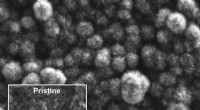
The team's findings, published in the journal Environmental Science and Technology, show that heavy metals can form a unique interface with water at the nanoscale, which leads to unexpected behavior that can significantly affect their environmental fate and transport.
"This work provides new insights into the behavior of heavy metals in the environment and has important implications for understanding their potential risks to human health," said Jiuhui "Jeff" Li, a PNNL materials scientist and corresponding author of the study.
Heavy metals are a group of elements with a relatively high density and atomic weight. Some heavy metals, such as lead, mercury, and cadmium, are known to be toxic and can cause serious health problems if they enter the environment or are ingested by humans.
Traditionally, heavy metals have been thought to be relatively immobile in the environment and to pose a relatively low risk to human health. However, recent studies have shown that heavy metals can be more mobile than previously thought, and that they can pose a significant risk to human health even at low levels.
The team's findings show that heavy metals can form a unique interface with water at the nanoscale, which leads to unexpected behavior that can significantly affect their environmental fate and transport.
At the nanoscale, water molecules can form a structured layer around heavy metal ions, which changes the surface properties of the heavy metal and makes it more mobile. This increased mobility can allow heavy metals to travel more easily through the environment and enter the human body.
The team also found that the unique interface between heavy metals and water can also affect the way that heavy metals interact with other chemicals and生物体. This can have a significant impact on the fate and toxicity of heavy metals in the environment.
"Our findings provide a new understanding of the behavior of heavy metals in the environment and have important implications for understanding their potential risks to human health," said Li. "We believe that this work will lead to new ways to mitigate the risks associated with heavy metals and protect human health."
In addition to PNNL, the research team included scientists from the University of Nebraska-Lincoln, the University of South Carolina, and the University of California, Berkeley.