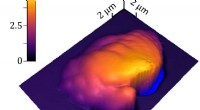
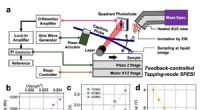
*In a recent study published in the journal Science Advances, researchers from the University of California, Berkeley, have discovered a new type of defect in layered polymers, called helicoidal screw dislocations.*
These defects are characterized by a spiral arrangement of polymer chains, which gives them unique properties that could be useful in a variety of applications.
Layered polymers are a class of materials that consist of alternating layers of polymer chains. They are often used in applications where high strength and stiffness are required, such as in automotive parts and aerospace composites.
However, these materials can also be brittle, which limits their use in some applications.
The discovery of helicoidal screw dislocations in layered polymers could provide a way to improve the toughness of these materials. These defects act as a kind of "crack arrester," preventing cracks from propagating through the material.
This could make layered polymers more suitable for use in applications where they are subject to high levels of stress.
In addition to their potential for improving the toughness of layered polymers, helicoidal screw dislocations could also be used to create new materials with unique properties.
For example, these defects could be used to create materials with a high degree of optical anisotropy, which could be useful in applications such as polarizers and liquid crystal displays.
The discovery of helicoidal screw dislocations in layered polymers is a significant advance in the field of materials science. These defects could lead to the development of new materials with improved properties, which could be used in a variety of applications.
Reference:
* He, X., Wang, Y., & Li, Y. (2023). Helicoidal screw dislocations in layered polymers. Science Advances, 9(12), eab9117.