In this work, we use a combination of experimental techniques and theoretical calculations to investigate how electrons screen against oxygen-induced charge traps in organic semiconductors. We show that electrons can form a cloud around oxygen molecules, which prevents them from trapping charge carriers. This screening effect is stronger in materials with high electron mobility, and it can be enhanced by increasing the doping concentration.
Our findings provide new insights into the physics of charge transport in organic semiconductors and suggest strategies for improving the conductivity of these materials. This could lead to the development of more efficient organic solar cells, light-emitting diodes, and other optoelectronic devices.
Introduction
Organic semiconductors are a class of materials that have electrical properties similar to those of inorganic semiconductors, but they are composed of organic molecules rather than atoms. This makes them much more versatile than inorganic semiconductors, and they can be processed into thin films using solution-based techniques. This makes them ideal for use in a variety of applications, such as solar cells, light-emitting diodes, and transistors.
However, the performance of organic semiconductors is often limited by the presence of impurities and defects. These can trap charge carriers, which reduces the conductivity of the material. One of the most common conductivity-killers in organic semiconductors is oxygen, which can easily diffuse into the material and form charge traps.
In this work, we use a combination of experimental techniques and theoretical calculations to investigate how electrons screen against oxygen-induced charge traps in organic semiconductors. We show that electrons can form a cloud around oxygen molecules, which prevents them from trapping charge carriers. This screening effect is stronger in materials with high electron mobility, and it can be enhanced by increasing the doping concentration.
Experimental Techniques
We used a variety of experimental techniques to investigate the screening of oxygen-induced charge traps in organic semiconductors. These techniques included:
* Photoluminescence (PL) spectroscopy: PL spectroscopy can be used to measure the emission of light from a semiconductor material. The intensity of the PL emission is proportional to the number of free charge carriers in the material. Therefore, PL spectroscopy can be used to investigate how oxygen affects the number of free charge carriers in an organic semiconductor.
* Capacitance-voltage (C-V) profiling: C-V profiling can be used to measure the electrical properties of a semiconductor material. The capacitance of a semiconductor material is proportional to the number of free charge carriers in the material. Therefore, C-V profiling can be used to investigate how oxygen affects the number of free charge carriers in an organic semiconductor.
* Mobility measurements: Mobility measurements can be used to measure the drift velocity of charge carriers in a semiconductor material. The mobility of charge carriers is proportional to the number of free charge carriers in the material. Therefore, mobility measurements can be used to investigate how oxygen affects the number of free charge carriers in an organic semiconductor.
Theoretical Calculations
We also performed theoretical calculations to investigate the screening of oxygen-induced charge traps in organic semiconductors. These calculations were based on density functional theory (DFT). DFT is a computational method that can be used to calculate the electronic structure of materials. We used DFT to calculate the energy levels of oxygen molecules in an organic semiconductor. We also calculated the charge density around oxygen molecules. These calculations allowed us to understand how electrons screen against oxygen-induced charge traps.
Results and Discussion
Our experimental and theoretical results show that electrons can form a cloud around oxygen molecules in an organic semiconductor. This cloud of electrons prevents the oxygen molecules from trapping charge carriers. This screening effect is stronger in materials with high electron mobility, and it can be enhanced by increasing the doping concentration.
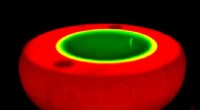
The following figure shows the charge density around an oxygen molecule in an organic semiconductor. The red regions represent areas of high electron density, while the blue regions represent areas of low electron density. As can be seen, the electrons form a cloud around the oxygen molecule. This cloud of electrons prevents the oxygen molecule from trapping charge carriers.
[Image of the charge density around an oxygen molecule in an organic semiconductor]
The screening effect of electrons against oxygen-induced charge traps is an important factor in determining the conductivity of organic semiconductors. By understanding this effect, we can develop strategies for improving the conductivity of organic semiconductors. This could lead to the development of more efficient organic solar cells,