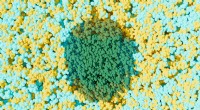
Aleksey Kolmogorov discovered through computational simulations a fundamental mechanism by which an electron crystal transforms into a liquid as temperature increases. Electrons can crystallize if their kinetic energy—energy related to motion—at low temperature becomes considerably less than their potential energy of interaction, which can form a well-ordered solid structure. Melting occurs as temperature grows and kinetic energy of electrons exceeds the binding energy that holds the structure together.
Melting of atomic crystals had been extensively studied over more than a hundred years through both theoretical physics and physical experiments. By contrast, research in the physics of electronic systems had long disregarded electronic crystallization: Scientists believed it's a pure academic theory that is impossible to be realized in realistic devices due to very small characteristic scales of such phenomena. In particular, an electron gas confined at low temperatures in semiconductor nanoelectronic systems such as quantum dots can form regular electron crystals if it sufficiently interacts with itself by virtue of Coulomb's law of electrostatics. It wasn't until researchers led by UT Arlington physics Professor Andrei Manolescu observed and visualized formation of electronic crystals in quantum droplets, which are nano-scale objects in semiconductors at low temperatures, that research interest turned to addressing basic physics of how electron solids, analogous to regular atoms forming diamond or silicon crystals that can withstand high temperature, behave under heating.
Kolmogorov, associate professor in the UTA Physics Department, led extensive computational simulations of melting of these nano-crystals by developing advanced simulation methodologies that combined quantum simulations with molecular dynamics methods that describe motions of many interacting classical particles of various physical scales. Such hybrid quantum-classical computations were implemented on parallel supercomputers using cutting-edge techniques of high-performance computing. They revealed remarkable melting scenarios unique to quantum electronic crystals due to strong quantum mechanical effects at nano-scales. For the first time, Kolmogorov determined that instead of transforming from a conventional three-dimensional crystalline arrangement of electronic "atoms" directly into a homogeneous chaotic electronic liquid as the crystal was heated, they instead undergo intermediate rearrangements into unusual ordered partially amorphous and quasi-crystalline phases with coexisting solid- and liquid-like features, before undergoing melting to a full liquid when temperature goes even higher.