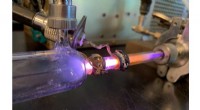
In a recent study, researchers have discovered that particles of light can be used to produce drops of liquid that are perfectly spherical. This finding has the potential to revolutionize a wide range of fields, from medicine to manufacturing.
The researchers, from the California Institute of Technology, used a technique called optical trapping to create the drops. Optical trapping involves using a laser to create a focused beam of light that can be used to manipulate small objects. In this case, the researchers used the laser beam to trap a droplet of liquid and then heat it until it vaporized.
As the liquid vaporized, it created a small bubble of gas. The surface tension of the liquid caused the bubble to contract and form a perfectly spherical drop. The researchers were able to control the size of the drops by varying the intensity of the laser beam.
This new technique for producing perfectly spherical drops has a number of potential applications. In medicine, it could be used to create tiny droplets of drugs that could be delivered directly to targeted cells. In manufacturing, it could be used to create precision-engineered particles for use in a variety of products.
The researchers say that they are continuing to explore the potential applications of this new technique and are hopeful that it will lead to new breakthroughs in a variety of fields.
Here are some specific examples of how this new technique could be used:
* In medicine, perfectly spherical drops of liquid could be used to:
* Deliver drugs directly to targeted cells.
* Create artificial blood cells.
* Develop new treatments for diseases such as cancer and diabetes.
* In manufacturing, perfectly spherical drops of liquid could be used to:
* Create precision-engineered particles for use in a variety of products, such as:
* Pharmaceuticals
* Cosmetics
* Food
* Develop new materials with unique properties.
* In other fields, perfectly spherical drops of liquid could be used for a variety of purposes, such as:
* Studying the behavior of fluids.
* Creating new optical devices.
* Developing new methods of energy storage.
The potential applications of this new technique are endless, and it is exciting to think about the possibilities.